GPT-6 Sol or Luna? Match the model to the work.
Choose Sol for complex coding and agentic workflows, or Luna for focused, high-volume tasks. Compare practical uses, API costs and usage limits.
- ChatGPT
- Claude
- Gemini
- Grok
- Cursor
- Perplexity
- + more
Mac & Windows
Our tools are trusted by 25,000+ AI heavy users.
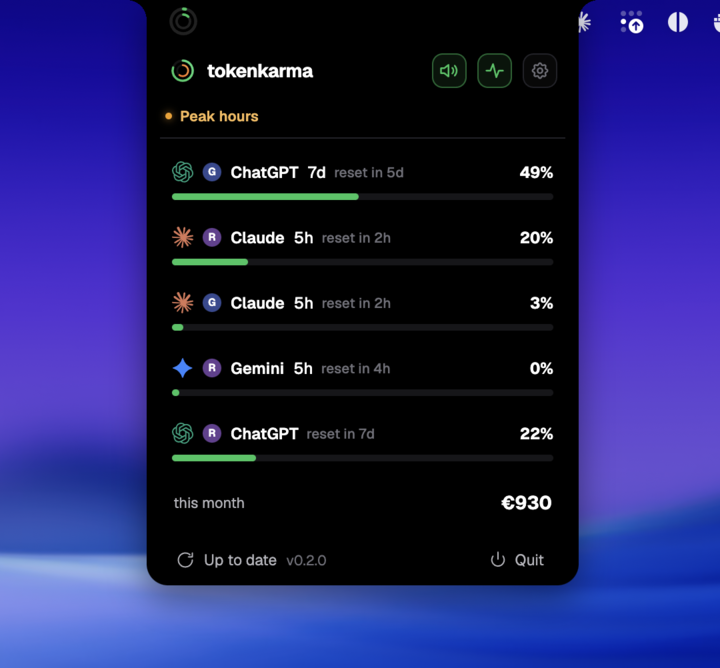
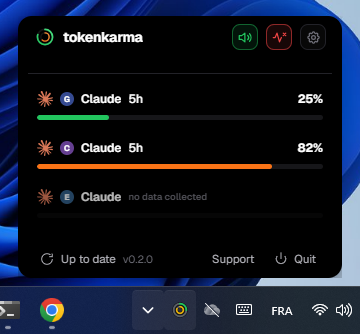
Your accounts. Your limits. Right on your desktop.
OpenAI positions GPT-6 Sol for complex coding and agentic workflows, and GPT-6 Luna for focused tasks at high volume. Start with the work you need done, then measure the quality and cost on your own examples.
Different tasks. Different starting points.
Sort the incoming work
Repeated, focused requests with a clear output format.
Try LunaResolve the complex cases
Coding problems that need several connected decisions.
Try SolSuggested routing: validate the sorting step and review the final answers.
Input / output in USD per million tokens. Base API rates, not subscription allowances. Actual cost depends on usage and processing options.
Choose Sol when the steps depend on each other
A change spanning several files, a difficult bug or a workflow that calls tools repeatedly is a sensible Sol trial. This is our recommended starting point for work that needs coordinated decisions, rather than many independent short answers.
Choose Luna when the task is narrow and repeated
Try Luna for labeling incoming requests, extracting fields or drafting short summaries in bulk. These are suggested use cases, not guarantees. Validate a sample first and send ambiguous cases to a more capable workflow or a human reviewer.
Why use both?
You do not have to pay the same cost for every step. For example, let Luna sort requests, then send the complex coding issues to Sol. Check whether the first step preserves the context needed by the second; routing errors can erase the savings.
Compare the right kind of cost
Standard API prices per million tokens are $2 input and $10 output for Sol, versus $0.10 and $0.50 for Luna. That is a 20-to-1 unit-price ratio, not a guarantee about task cost or quality. Longer prompts, tools and processing options can change the bill.
API limits depend on your tier
API requests and tokens per minute depend on the usage tier of your organization. The two models have separate published rate-limit tables. Check those tables and your project limits before estimating batch throughput.
Subscription allowances are a separate question
Do not convert API prices into a number of ChatGPT or Codex messages. Availability and included usage depend on the product and plan. Follow the usage windows exposed by your account, rather than assuming each model has an independent allowance.
Keep the next limit in sight.
Bring the usage readings and reset times reported by your connected account onto your desktop. TokenKarma shows the counters your provider exposes; it does not create a separate quota for every model name.
Frequently asked questions
Is Luna always the better value?
Only if it meets your quality requirements. Compare successful outcomes, including retries and review time, rather than token price alone.
Can I use Sol and Luna in the same workflow?
Yes, you can route different API tasks to different models. Our example uses Luna for initial sorting and Sol for complex coding work; test the routing and final answers before relying on it.
Does TokenKarma invent a separate limit for each model?
No. TokenKarma follows the available provider readings. A shared account counter remains shared even when you change models.
Sources, checked September 25, 2026
- OpenAI: GPT-6 Sol specifications, pricing and rate limits
- OpenAI: GPT-6 Luna specifications, pricing and rate limits
Independent guide. Your provider’s current account settings determine your available limits.