Self Host an LLM: Meta's 816B Muse Spark Open Cost Math
Meta open-sourced Muse Spark Open, an 816B model that runs on two Mac Studios. Here is when self hosting beats your monthly API bill.
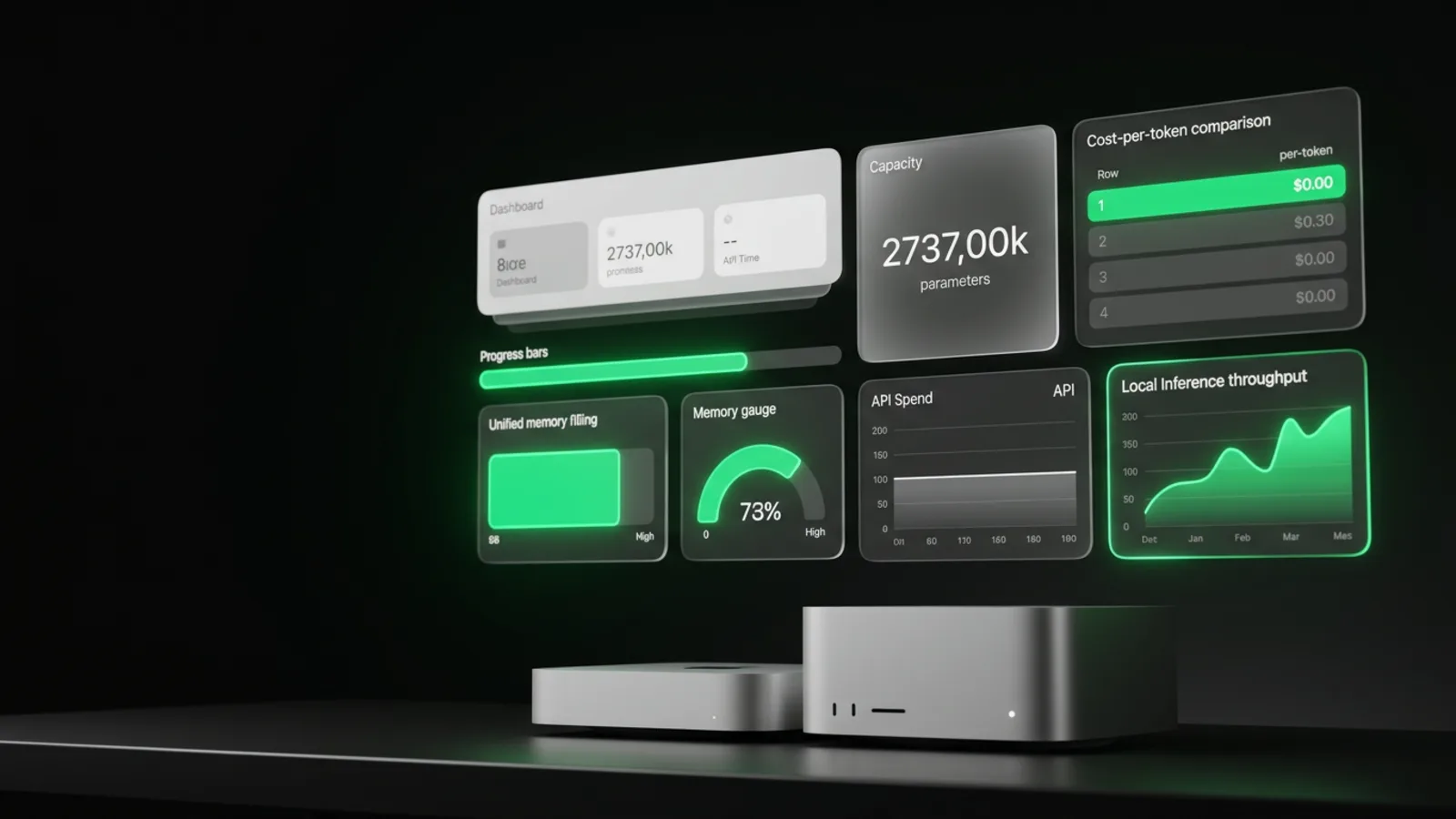
On October 15, 2026, Meta gave self-hosting its strongest argument yet: Muse Spark Open, an 816 billion parameter model with downloadable weights, running on two Mac Studios sitting on a desk.
For anyone paying 300 dollars or more per month across Claude, ChatGPT, Gemini and Cursor, the question stops being philosophical. A frontier-class model you can own competes directly with a frontier-class model you rent. The bill is not the only variable, and the sticker price is not the whole cost. But the math changed this week, and it is worth running the numbers on your own workload before you renew anything.
What Meta actually released
Muse Spark Open is a mixture-of-experts model: 816B total parameters with 42B active per token, a 1M token context window, and native multimodality. Meta calls it the most capable US open-weight model to date, and the benchmarks back the claim on agentic work, long-horizon tasks, and multi-step software engineering. Independent trackers note it still trails Kimi K3 on some coding and reasoning evaluations, so it is not the absolute frontier. It is close enough that the gap stops being the deciding factor for most heavy users.
The part that matters for your wallet is distribution. Weights are on Hugging Face, Amazon SageMaker AI, Google Cloud Model Garden, and Microsoft Foundry Models. Hosted inference runs through Together AI, Fireworks, Baseten, Modal, Groq, Nebius, and OpenRouter. On OpenRouter the model lists at 1.25 dollars per million input tokens and 4.25 dollars per million output tokens. That is roughly a third of Claude Opus 5.5 at 4 and 20, and well under GPT-6.1 Sol at 2 and 10.
You read that correctly. The same week an open-weight model arrived, it landed cheaper per token than every closed frontier option you are currently paying for.
The two ways to self host an LLM, and who each one fits
There are two distinct paths, and conflating them is where most cost estimates go wrong.
The first is hosted-open: you call Muse Spark Open through OpenRouter, Fireworks, or Groq and pay per token. You get the price advantage of an open model with zero hardware, zero maintenance, and zero operational risk. If you already route through a gateway, this is a config change, not a project. For a heavy user spending 300 dollars a month on closed models, moving the bulk of routine work to a 1.25 dollar input model can cut the bill by more than half without touching a single cable.
The second is true self hosting: you download the weights and run them on hardware you own. Meta optimized Muse Spark Open for Apple silicon through MLX, and the reference setup is two Mac Studio machines with M5 Ultra chips. Each holds up to 512GB of unified memory, and at 1.2 TB/s of memory bandwidth the pair behaves like one machine with a terabyte of unified memory. That is what lets an 816B model fit on a desktop at all.
There is a third path in between, which is renting a GPU by the hour. On-demand H100 and B200 instances remain the most expensive way to run a model continuously, because you pay for idle time. They make sense for burst evaluation, not for a model you query all day.
The actual break-even math
Self hosting only wins on cost if you use the model enough, and “enough” is higher than most people assume.
Two Mac Studios with M5 Ultra land somewhere in the range of 14,000 to 20,000 dollars depending on memory configuration. Add power, cooling, and the fact that you replace the hardware every three to four years. Spread over 36 months, that is roughly 400 to 600 dollars per month in amortized cost, before you count a single hour of your own time.
That means the break-even point sits well above the average heavy user’s spend. If you pay 300 dollars a month, buying hardware to replace that bill does not pay back inside the hardware’s useful life. If you run agents continuously, batch overnight, or push millions of tokens a month, the crossover arrives much sooner, and the hardware stops being a cost center and becomes capacity you control.
The hosted-open route has no break-even at all, which is why it is the right first move for almost everyone. You capture the price drop immediately and keep your options open while you measure whether your real usage justifies owning iron.
What self hosting a large model actually costs beyond hardware
The hardware line is the easy one. The operational lines are where budgets quietly break.
Throughput on two Mac Studios is respectable but not equal to a datacenter cluster. If your workflow depends on many parallel agent sessions, local inference will queue. Latency per token is fine for interactive work and worse for long batch runs. You also own uptime: no status page will tell you why the model is slow at 2am, because you are the status page now. Updates, quantized weight variants, kernel tuning, and the MLX stack are all yours to maintain.
Then there is quality risk on specific tasks. Muse Spark Open leads on agentic benchmarks but trails Kimi K3 on parts of coding and reasoning. If your revenue depends on the coding benchmark where it loses, the cheaper token is not cheaper. The correct test is to run your top three real prompts through both models and compare finished output, not leaderboard position.
Finally, check the license. Meta released the weights under the Muse Model License with limited commercial terms that allow many developers to use the model for free. Read those terms before you ship a product on top of it. For individual heavy users the terms are generous; for commercial redistribution they are not automatic.
How this fits next to Claude, GPT-6 and Gemini
The interesting thing about October 2026 is that the open and closed sides moved in opposite directions in the same week.
Google announced that Gemini 4 Argon intro API pricing doubles on December 1. Anthropic halved Sonnet 5.5 cache-read cost. OpenAI retired GPT-5.5 from ChatGPT and Codex while pushing GPT-6.1 Sol. And Meta dropped an 816B open-weight model priced to undercut all of them on OpenRouter. The direction of your bill now depends heavily on which provider you anchor to, and on whether you keep a second option live.
For heavy users, the practical posture is a portfolio, not a loyalty. Keep a closed frontier model for the tasks where it still wins. Route high-volume routine work to an open-weight model at a third of the price. Hold the self-hosting question open until your measured usage clears the break-even, then decide with numbers instead of vibes.
What to do this week
If you are spending more than 300 dollars a month on AI, run this sequence before your next renewal.
First, measure. Pull your last 30 days of token usage per provider. Most people discover that the majority of their spend goes to routine work that a cheaper model handles identically. Second, route the routine volume to Muse Spark Open through OpenRouter or Fireworks and watch the delta for a week. Third, benchmark the model on your top three prompts, not on a public leaderboard, to confirm the quality holds. Fourth, only then evaluate hardware: if your post-rerouting spend still exceeds 500 dollars a month and your usage is steady, two Mac Studios start to make sense, and the model you run is one you own outright.
Self hosting an LLM stopped being a hobbyist project the moment a US lab shipped frontier-class open weights that fit on a desk. Whether it saves you money is a function of how much you actually use it. Now you have the numbers to find out.
Now available
Stop guessing your AI limits
The Mac app and web dashboard watch your Claude, ChatGPT, Gemini and more, and warn you before quotas hit.