Local LLM on a Gaming PC: A 125B Model Now Beats Your API Bill
Searches for local LLM are up more than 1000% as a 125B model now runs on a 12 GB gaming GPU for free. The real math against your API bill.
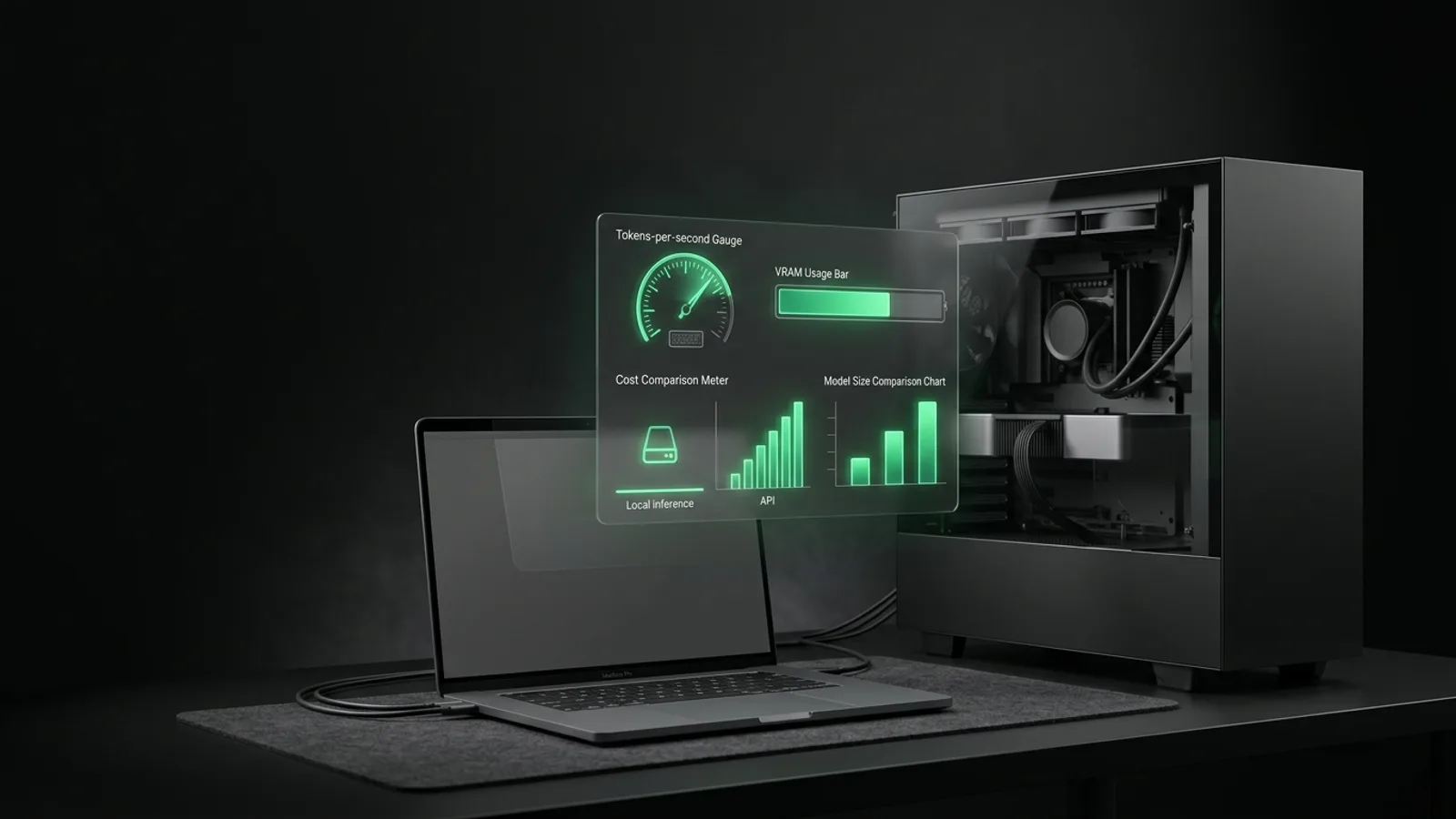
Searches for “local llm” are up more than 1000% in three months, and searches for “self hosted llm” jumped 1131%. That is not a niche hobby trend anymore. It is a cost signal. On October 3, 2026, a project called Strata hit the top of Hacker News with a claim that would have been absurd a year ago: it runs Qwen3.8-Flash-Next, a 125-billion-parameter model, on an ordinary gaming PC with a 12 GB graphics card, at up to 94 tokens per second, for free.
For anyone paying 200 dollars or more per month across Claude, ChatGPT, Gemini and a coding agent subscription, this changes the arithmetic on part of their workload. Not all of it. But enough to matter.
What actually changed with local LLM in 2026
Until recently, “run a model at home” meant two bad options. You ran a small 7B or 8B model that was fast but could not hold a complex coding task, or you bought a workstation GPU and paid four figures to run something decent. The 125B class, the size that actually competes on reasoning and code, lived on servers behind an API meter.
Three things moved at once:
- Quantization got good enough to trust. The Strata release ships the same 125B model in a spread of compressed formats (Q2_0 through IQ3_S and a Coder variant). The compressed weights fit in 12 GB of VRAM without collapsing output quality the way aggressive quantization used to.
- Open weights arrived from serious labs. Qwen3.8-Flash-Next is a genuine frontier-adjacent model, not a toy. Aleph Alpha’s Kolibri release in the same window pushed the “sovereign open-weight model” idea into enterprise conversations.
- Consumer silicon caught up. An RTX 5070 with 12 GB is a mid-range card. An RTX 3090 with 24 GB, which many people already own for gaming, is reported to write 100 to 140 tokens per second on this model. That is server-class throughput on hardware already sitting on a desk.
The headline number people remember is “125B on a gaming PC.” The number that matters is dollars per million tokens, and that number just went to zero for the marginal call.
The real cost math for heavy users
A heavy user on the top consumer tiers is spending somewhere between 200 and 500 dollars per month, often across more than one provider. That spend buys three different things, and they do not have the same value:
- Interactive work. Chat, brainstorming, quick edits. Latency matters, quantity is low.
- Bursty agentic work. Long coding runs, repository migrations, test-fixing loops. Volume is huge and it is exactly what blows through weekly caps.
- Sensitive or regulated work. Anything you would rather not send to a third party at all.
Local inference does not replace category 1 well, because frontier closed models are still better at the hardest interactive reasoning and you pay for convenience. It attacks category 2 hard, because those runs are high-volume, low-per-turn-value, and repeatable. It owns category 3 outright.
Run the numbers on a real workload. A coding agent that burns 20 million tokens a month on a frontier API at roughly 10 dollars per million input and 50 dollars per million output is a 300 to 500 dollar line item. If half of that traffic is the repetitive, lower-difficulty portion of the loop, moving just that half to a local model on hardware you already own removes it from the meter permanently. The first month of a 12 GB card pays for itself against a mid-tier subscription. The card keeps working after that.
That is the shift the search data is reflecting. When “local llm” trends 1000% and “ai spend” trends 45% in the same quarter, the audience is not asking whether local works. They are asking what to move off the API.
Where local LLM is worse, and why it matters
Be honest about the trade-offs, because a bad recommendation costs more than a subscription.
- Quality ceiling. A 125B model at Q3 quantization is impressive but not equal to a frontier closed model at full precision on the hardest tasks. For a gnarly architecture decision or a subtle bug in unfamiliar code, the frontier API still wins.
- Context and throughput. Local context windows are real but throughput on very long prompts drops. Reading a 32K-token document runs at a couple thousand tokens per second on the strongest tested cards, and far less on weaker ones. A frontier API has no equivalent wall.
- Ops load. You now patch, update, and monitor a local stack. There is no status page to blame when it fails.
- Sizing discipline. The model only fits because of quantization. If your work needs the highest fidelity output, you are back on the API.
The practical answer is a split, not a switch. Route the repeatable, high-volume, lower-difficulty traffic locally and keep a frontier API for the hard calls. That is the same split-routing discipline that heavy users already apply across Claude, ChatGPT and Gemini. Local is just one more route on the list, and it is the cheapest one.
How this fits next to Claude, ChatGPT and Gemini
This is not a Claude-only story, and it should not become one. Every major provider now sells a subscription with a moving usage allowance, and every one of them has raised or reshaped limits in the past quarter. OpenAI cut the 200 dollar Pro tier’s allowance and repriced the top end. Anthropic keeps three interacting meters (session window, weekly cap, per-product pools) on the Max plans. Google keeps shipping API pricing changes that double effective cost for some agent workloads.
Local inference is the only route on the board whose unit cost does not move when a vendor decides to change a meter. That does not make the subscriptions worthless. It makes them a component you should be able to bypass for the traffic that does not need them.
The providers that are paying attention to this trend are the ones shipping open weights and self-host paths, because they know the alternative is watching their heaviest users move half their volume off the meter.
What to actually do
- Measure your token split first. Log two weeks of usage and separate interactive traffic from bursty agentic traffic. You cannot route what you have not measured.
- Pick the repetitive half to move. Start with the loops that repeat, not the tasks that need judgment.
- Check your existing hardware. If you already own an RTX 3090, 4070, 4080 or a Radeon 9000-series card with 12 GB or more, you may not need to buy anything.
- Start with a compressed model. The IQ3 class gives the best quality-to-size ratio for a 125B model on 12 GB. Do not chase the smallest format if quality matters.
- Keep a warm fallback API. A local route that fails should fail over to a frontier provider, not stall your run.
- Track cost per completed task, not cost per token. The local route wins on tokens. Confirm it wins on shipped output.
- Recheck monthly. Quantization and open weights are improving fast. The route that did not work last quarter may work now.
The part that will not change
Hardware now runs a 125B model that would have needed a server last year, and the price of that capability is falling on both sides: cheaper quantized models and cheaper capable GPUs. The subscription model is not going away, but the assumption that heavy AI use must be rented is getting weaker every quarter.
The users who come out ahead are the ones who treat every route, local and API, subscription and self-hosted, as interchangeable capacity with a measurable cost per result. The ones who come out behind are the ones who keep paying a meter they could have turned off for half their workload.
Now available
Stop guessing your AI limits
The Mac app and web dashboard watch your Claude, ChatGPT, Gemini and more, and warn you before quotas hit.