DeepSeek Adds Off-Peak Pricing: Cut Your V4-Flash API Bill in Half
DeepSeek will charge 2x for peak-hour tokens and just released V4-Flash-0731 with a major agent upgrade. Here is what heavy AI users save by shifting workloads off-peak.
DeepSeek dropped two announcements on July 31, 2026 that matter more to heavy AI users than the raw model numbers suggest. First, the public beta of DeepSeek-V4-Flash-0731 is live with a substantial agent upgrade. Second, and more quietly, DeepSeek confirmed it will introduce peak and off-peak pricing with a 2x surcharge during peak hours. For anyone running large batches on the DeepSeek API, that second change is the one that changes your monthly bill.
The V4-Flash model was already the cheapest credible coding agent on the market at $0.14 per million input tokens and $0.28 per million output tokens. The new release keeps the same architecture and the same price, but re-post-trains the weights so the agent benchmark scores jump well past the V4-Pro-Preview. The news is not a price cut. It is a capability upgrade plus a new billing structure that rewards users who can shift their workload by a few hours.
The peak-hour surcharge is the real story
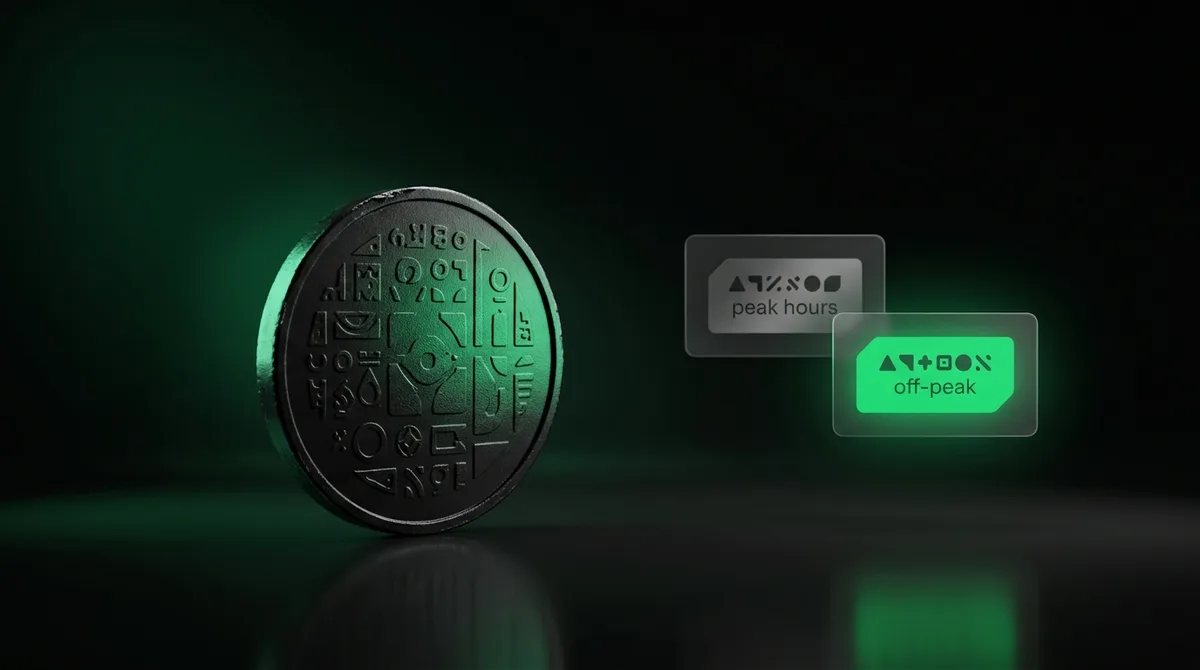
DeepSeek’s pricing page now notes that the service will soon adopt a peak and off-peak policy. During peak hours, prices will be 2x the regular price, applied to every billing item including input, output, and cached tokens. Peak hours are defined as 9:00 to 12:00 and 14:00 to 18:00 Beijing time, which is UTC+8.
That matters because of geography. Business hours in Beijing overlap with morning and afternoon work hours across much of Asia, and they conveniently sit outside the late-night and early-morning windows in North America. For a developer in San Francisco or New York running nightly batch jobs, the arithmetic is straightforward: move the work to off-peak and effectively get the current prices, or keep it in peak and pay double.
DeepSeek has not yet published the exact off-peak discount schedule, only the 2x peak multiplier. The effective date is also still to be announced. But the direction is clear. The model is positioning itself as the volume player, and it is nudging heavy users to smooth their demand curve just like cloud providers have done for years.
Why the agent upgrade matters for cost
The new V4-Flash-0731 post-train pushes agent benchmarks far beyond the V4-Pro-Preview. On Terminal Bench 2.1 it scores 82.7, on Cybergym 76.7, on Toolathlon verified 70.3, and on DeepSWE 54.4. Those are frontier-level coding agent numbers on a model that costs a fraction of Claude Code or GPT-5.6 alternatives.
For a heavy AI user paying $300 or more a month across providers, this changes the build-vs-buy calculation for coding agents. If you currently run thousands of agentic tasks per month on a pricier model, a chunk of that workload can move to DeepSeek-V4-Flash without a visible drop in task completion. The Responses API is now supported natively and the model is specifically adapted for Codex, which lowers the integration cost further.
The savings stack up quickly. At $0.28 per million output tokens, DeepSeek-V4-Flash is around an order of magnitude cheaper per token than most US flagship output prices. Even with the 2x peak multiplier, off-peak V4-Flash output still undercuts almost every competitor.
What to watch before you rebalance
There are three caveats worth tracking before you point your whole pipeline at DeepSeek.
First, the cache-hit price is the hidden lever. DeepSeek charges $0.0028 per million cached input tokens, versus $0.14 on a cache miss. That is a 98% discount, and it is the cheapest cache-hit rate of any major provider. If your prompts share prefixes, the cost of a large batch collapses. But the peak multiplier applies to cached tokens too, so hitting the cache during off-peak windows is where the real saving lives.
Second, concurrency limits differ sharply by model. V4-Flash allows a 2500 concurrency limit while V4-Pro is capped at 500. For bursty agent workloads, that headroom on the flash model removes a rate-limit headache entirely.
Third, V4-Pro is officially unchanged so far. DeepSeek says the full V4-Pro release will follow soon, and the Responses API support for V4-Pro lands in early August. If your workload needs the larger model, plan for that transition rather than assuming this week’s update applies to both.
The bottom line for heavy users
The combination is unusual. DeepSeek just made its cheapest coding model meaningfully smarter and simultaneously introduced a pricing structure that rewards off-peak usage. Both moves push in the same direction: route your flexible, batchable workloads to DeepSeek-V4-Flash and run them outside Beijing business hours.
Shift a significant share of your agentic tasks to off-peak DeepSeek-V4-Flash and the per-task cost drops to a level no US provider currently matches. The trade-off is a 1M-token context window that is generous, a thinking mode that is on by default, and a model that is young enough that benchmark claims deserve a real-world test on your own task mix before you commit a production pipeline.
DeepSeek’s change log frames this as an API update. For anyone watching their monthly AI spend, it reads more like a pricing arbitrage opportunity. The users who win are the ones who adjust their schedules before the peak and off-peak policy officially goes live.
Now available
Stop guessing your AI limits
The Mac app and web dashboard watch your Claude, ChatGPT, Gemini and more, and warn you before quotas hit.