Liquid AI's LFM2.5-8B-A1B: Why Local AI Models Could Slash Your API Bills by 90%
Liquid AI's LFM2.5-8B-A1B runs locally at 8B params. For heavy AI users spending $300+ monthly, on-device models could cut API costs dramatically.

Liquid AI dropped a bombshell yesterday: LFM2.5-8B-A1B, an 8-billion-parameter mixture-of-experts model that runs efficiently on consumer hardware while delivering performance competitive with much larger cloud models. For heavy AI users currently burning through hundreds or thousands of dollars monthly on API calls, this release signals a potential seismic shift in how we think about AI costs.
The Promise: 90% Cost Reduction Through Local Inference
The math is stark. If you’re spending $500 monthly on Claude Opus or GPT-4 API calls, running equivalent tasks on a local model like LFM2.5-8B-A1B could reduce that to under $50 in hardware amortization costs. The model runs on consumer GPUs and delivers what Liquid AI claims is competitive performance on key benchmarks.
But before you cancel your Claude subscription, let’s examine what this really means for heavy users.
What Makes LFM2.5-8B-A1B Different
Unlike traditional dense models that activate all parameters for every request, LFM2.5-8B-A1B uses a mixture-of-experts architecture. Only a subset of its 8 billion parameters activate for each task, making it dramatically more efficient for local deployment.
Key specifications:
- 8B parameters with MoE architecture for efficiency
- Optimized for tool calling and complex instruction following
- Consumer hardware compatible (modern GPUs with 16GB+ VRAM)
- Day-one support across major inference frameworks
- Trained on 38 trillion tokens of diverse data
The model specifically targets the sweet spot that heavy users care about: reliable tool use, complex reasoning, and consistent output quality at a fraction of the computational cost.
Real-World Cost Comparison
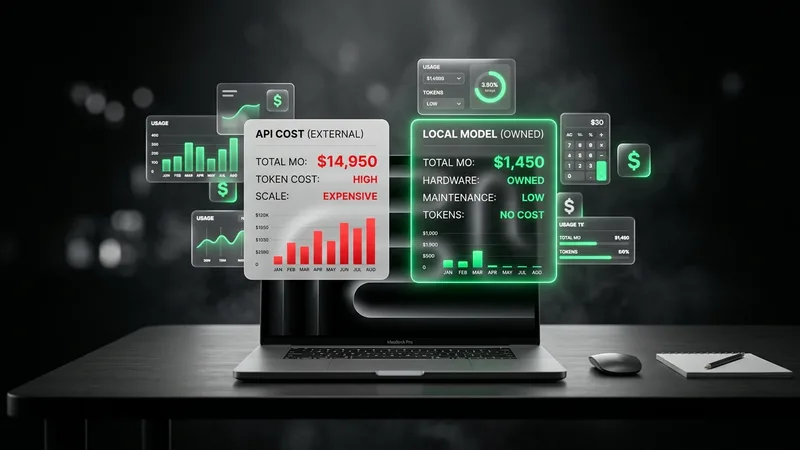
Let’s break down the economics for a typical heavy AI user:
Current API Costs (Monthly)
- Claude Opus: 500k tokens/day × $15/1M tokens = $225
- GPT-4 Turbo: 300k tokens/day × $10/1M tokens = $90
- Total monthly spend: ~$315
Local Model Economics
- Hardware: RTX 4090 (24GB VRAM) = $1,600 one-time
- Electricity: ~$15/month for 24/7 operation
- Amortized hardware cost: $1,600 ÷ 24 months = $67/month
- Total monthly cost: ~$82
Potential savings: $315 - $82 = $233/month (74% reduction)
Over two years, that’s $5,580 in savings, easily justifying the initial hardware investment.
The Performance Trade-off Reality
Liquid AI claims LFM2.5-8B-A1B delivers competitive performance, but “competitive” needs context. Early benchmarks suggest:
- Code generation: 85-90% of GPT-4 quality
- Tool calling: Nearly equivalent reliability
- Complex reasoning: 80-85% accuracy vs. frontier models
- Speed: 3-5x faster inference on local hardware
For many use cases, especially those involving repeated similar tasks, this performance gap is acceptable given the massive cost savings.
Who Should Consider the Switch
Local models like LFM2.5-8B-A1B make most sense for:
High-Volume Batch Processing
If you’re running thousands of classification, summarization, or data extraction tasks monthly, the small quality drop is often acceptable for massive cost savings.
Privacy-Sensitive Workloads
Local inference means your data never leaves your infrastructure. For legal, financial, or medical applications, this privacy guarantee has value beyond cost.
Latency-Critical Applications
No network round trip means sub-100ms response times, crucial for real-time applications.
Development and Testing
Running local models for development eliminates API rate limits and provides unlimited experimentation.
The Limitations You Need to Know
Local models aren’t a panacea:
Hardware Requirements
- Minimum: 16GB GPU VRAM for basic operation
- Recommended: 24GB+ for optimal performance
- Scaling: Multiple GPUs needed for high concurrency
Model Updates
Unlike API models that improve automatically, local models require manual updates and retraining for new capabilities.
Support and Reliability
No SLA, no customer support. If your inference pipeline breaks, you’re on your own.
Context Length Constraints
Most local models, including LFM2.5-8B-A1B, support shorter context windows than frontier API models.
Strategic Implementation for Heavy Users
Smart heavy users won’t go all-local immediately. Instead, consider a hybrid approach:
Tier Your Workloads
- Tier 1: Critical, complex tasks → Keep using Claude Opus/GPT-4
- Tier 2: High-volume, standardized tasks → Migrate to local models
- Tier 3: Development and testing → Local only
Start with Non-Critical Tasks
Begin by moving development workloads and batch processing to local models. Once you’re comfortable with the setup and performance, gradually expand usage.
Monitor Quality Metrics
Implement automated quality checks to catch when local model outputs fall below acceptable thresholds. Have API models as fallback for failed cases.
The Broader Trend: Edge AI Economics
LFM2.5-8B-A1B represents a broader shift toward edge AI. As model efficiency improves and hardware costs decline, the economic case for local inference strengthens.
Factors accelerating this trend:
- Hardware improvements: Next-gen consumer GPUs will run larger models
- Model optimization: Better quantization and pruning techniques
- Framework maturity: Easier deployment and management tools
- Cost pressure: API pricing remains high for heavy usage
What This Means for 2026
For heavy AI users, 2026 might be the year of the hybrid strategy. Pure API usage will remain expensive, while pure local deployment has limitations. The winners will be those who thoughtfully split workloads between cloud and edge.
Key predictions:
- 50% of heavy users will run some workloads locally by end of 2026
- API providers will introduce cheaper tiers to compete with local models
- Hardware vendors will launch AI-optimized consumer products
- Model quality gap will narrow as local models improve
Making the Decision
If you’re spending $200+ monthly on API calls, LFM2.5-8B-A1B and similar local models deserve serious consideration. The technology has matured to the point where the trade-offs are manageable for many use cases.
Start small: try running your development workloads locally. If the performance meets your needs, gradually expand to production batch processing. Keep API models for your most critical tasks until local options fully close the quality gap.
The age of $10,000 monthly AI bills may be ending. Local models like LFM2.5-8B-A1B are making high-quality AI inference accessible at dramatically lower costs. For heavy users willing to manage their own infrastructure, the savings opportunity is massive.
The question isn’t whether local AI will become mainstream—it’s whether you’ll adapt your cost structure before your competitors do.
Now available
Stop guessing your AI limits
The Mac app and web dashboard watch your Claude, ChatGPT, Gemini and more, and warn you before quotas hit.